
How to Build Authority in Your Creative Field Through Education (Even Without Years of Experience)
Feb 05, 2026You're talented. Your portfolio is strong. Your work creates real impact for clients.
So why does the designer down the street—who started their business the same year you did—get invited to speak at industry events while you're still waiting to be discovered?
Why does that photographer with comparable skills command double your rates and get featured in design publications?
Why do some creatives become recognized authorities in their field within 3-5 years, while others spend decades hoping someone will finally notice their expertise?
Here's the uncomfortable truth: Expertise alone doesn't build authority. The ability to articulate and demonstrate that expertise does.
And the fastest way to bridge that gap? Strategic education.
And before you roll your eyes thinking "great, another person telling me I need more credentials"—stay with me.
This isn’t about going back to school for another degree (unless that's your thing, in which case, rock on ✨).
This isn’t about collecting certificates like Pokémon cards.
It's about accelerating the recognition you deserve for work you're already doing exceptionally well.
In this post, you'll discover:
- Why experience alone doesn't build authority (and what does)
- How strategic education accelerates credibility faster than portfolio-building
- A real story of a creative who built industry authority through one educational decision
- The 5-step framework for using education to position yourself as THE expert
- Education options across creative disciplines (not just for designers or photographers)
By the end, you'll understand exactly how to use education as your authority-building secret weapon—so you can finally be seen for the expert you already are.
Let's dive in. ✨
Why Most Creatives Struggle to Build Authority (Even When They're Incredibly Talented)
Let's start with a reality check.
You have the skills. You've done the work. You've delivered exceptional results for clients.
But when someone asks "what makes your approach different?" or "why should I hire you specifically?"—do you have a clear, compelling answer? Or do you find yourself defaulting to "I just have an eye for it" or "years of experience"?
(I need you to really hear that. Your imposter syndrome is lying to you—the issue isn't your talent. It's how you communicate it.)
Here's what happens: Two photographers attend the same event. Same level of talent. Similar portfolios. Same years in business.
Photographer A talks about their work in vague terms: "I capture authentic moments." "I have a unique style." "My clients love working with me."
Photographer B references visual psychology, color theory application, and storytelling frameworks. They explain why certain compositions create emotional impact. They cite research on how specific lighting techniques trigger neurological responses.
Both photographers create beautiful work. But Photographer B commands 2-3x higher rates and gets referrals from interior designers, architects, and luxury brands who specifically seek photographers who "understand the science of visual storytelling."
The difference isn't their talent. It's their ability to articulate the 'why' behind their work.
Why Experience Alone Doesn't Build Authority
Most creatives develop incredible instincts through practice. You know what works—you've seen it proven over and over in your client projects.
But here's the problem: Intuitive expertise without frameworks feels like guessing (hello, imposter syndrome), even when you're consistently right.
When you can't explain why your approach works, several things happen:
- You second-guess yourself constantly. Without frameworks to validate your instincts, there's always that voice: "Am I making this up? What if I'm just lucky?"
- Clients undervalue your work. When you can't articulate your methodology, clients assume you're "just creative" rather than strategic. They push back on pricing because they don't understand the depth of expertise they're actually getting.
- You sound like everyone else. "I'm passionate about design." "I create beautiful spaces." Cool. So does everyone else on Instagram. (Just saying. 💁♀️)
- You can't differentiate yourself. Without specific frameworks or methodologies to reference, your positioning becomes "I do what other [designers/photographers/strategists] do, but trust me, I'm better."
That's not a positioning problem. That's an articulation problem.
And that's where strategic education becomes your unfair advantage. ✨

The Education Advantage: Why Strategic Learning Accelerates Authority
Once you understand the authority gap, the solution becomes obvious: strategic education.
But let me stop you right there—this isn't about learning your craft. You already know how to design, photograph, strategize, or create.
Strategic education teaches you the 'why' behind what you already do instinctively. It gives you:
1. Frameworks That Make Your Expertise Communicable
When you learn the science, research, or methodology behind your intuitive approach, you can finally explain why your work delivers results.
Instead of "I just have an eye for it," you can say: "I apply principles of color psychology and spatial flow based on environmental design research to create spaces that reduce stress and increase focus."
Don’t get me wrong. Your creative instinct is real and valuable—but pairing it with frameworks makes you unstoppable.
That shift changes everything. Client conversations. Website copy. Sales pitches. Content creation. Suddenly, you're not hoping people will "get it"—you're confidently explaining why they should work with you.
2. The Validation Effect: How Knowledge Builds Confidence
Here's what we don't talk about enough: imposter syndrome isn't just insecurity. It's the absence of validation.
You know your work impacts people. But when you can't explain why it works, there's always that voice: "Am I making this up? What if I'm wrong?"
Strategic education transforms this. When you learn the science behind what you've been doing intuitively, you move from "I think this works" to "Research shows this works."
"The whole feeling of being validated that your instincts and intuition have been right, is really uplifting," one creative shared after completing her certification.
That shift changes how you show up in client conversations, how you price your work, how you position your services. And clients can feel that confidence—they know the difference between someone hoping their work will resonate and someone who knows it will deliver.
(And honestly? If you've been second-guessing your expertise despite years of good work, education might be the validation you've been craving all along. Just saying. 💁♀️)
3. The Opportunity Magnet: How Education Opens Doors
When you have demonstrable expertise—certifications, frameworks you can reference, methodologies you can teach—opportunities start appearing.
Speaking engagements. Podcast interviews. Media features. Teaching positions. Industry partnerships. High-value client referrals.
These aren't magic. They're the natural result of positioning yourself as someone with knowledge worth sharing.
One interior designer described this phenomenon: "The thing about manifesting is huge." After completing her certification in science-based design, speaking opportunities, panel invitations, and industry recognition followed naturally—not because she marketed harder, but because her positioning shifted from "designer who creates beautiful spaces" to "expert in environmental psychology and biophilic design."
That's the education advantage. It doesn't just improve your work (you're already good). It makes your expertise visible, credible, and valuable to exactly the clients, collaborators, and opportunities you want to attract.
Want to see how strategic education transformed real creative businesses? Watch our free masterclass: What High-Earning Creatives Do Differently—including how they use education to command premium rates. ✨
Want to see how this plays out in real life? Let me show you.
Real Story: How One Creative Built Industry Authority Through Strategic Education
Let me introduce you to Janet. Interior designer. Incredibly talented. Knew her work had impact—she could feel it—but couldn't explain why.
"Two years ago, actually many years ago, I was interested in this topic because I knew what we did had an impact. I just didn't know, I couldn't find any books on environmental psychology. I couldn't find anything."
She was stuck in that frustrating gap between intuitive expertise and articulated authority. Her work was exceptional, but she lacked the frameworks and language to communicate what made it exceptional.
Then she found a certification program in science-based design. Her reaction? "Oh my God, this is it."
(We've all had that moment, right? When something just clicks and you know it's exactly what you've been searching for.)
The Commitment: One Hour a Day Changed Everything
Here's what I love about Janet's story: she didn't quit her business, take a sabbatical, or carve out massive chunks of time.
She committed to one hour a day. Or every other day. Whatever she could manage.
"So what I did was I did the certification class. You can do it. I committed to an hour a day or an hour every other day or whatever and got through the whole thing."
One hour. Less time than you spend scrolling. But that small, consistent investment compounded into transformation
The Transformation: Validation, Language, Opportunities
The education didn't teach Janet how to design—she already knew that. What it gave her was proof she'd been right all along.
"You need to look at these things, read about them, and then you'll see you've been using them, you've been using them for years."
"Now what this science and design has done for us is validating what we've been doing and giving us the language in which to talk about it."
Client conversations shifted. She wasn't just "a designer who creates beautiful spaces." She became "the designer who uses environmental psychology and biophilic design to create spaces that reduce stress and increase well-being."
Then the opportunities: speaking engagements, panel discussions, industry recognition, clients specifically seeking her expertise.
It wasn't magic. It was positioning. She educated herself strategically, and the industry responded.
"Just grab it and make it your own if you really want to do this. And again it's work. But I find it fascinating and it energizes me and I just keep having conversations with people."
That's what authority looks like: not burnout from proving yourself, but energy from finally being recognized for what you know. ✨

What This Means for You (No Matter Your Creative Discipline)
Janet's story is about interior design, but the pattern works across every creative field:
- Photographer learning composition theory + visual psychology → "I don't just capture moments—I use narrative composition principles that create images your brain is wired to remember."
- Brand strategist studying consumer psychology → "I don't just design logos—I build brand identities grounded in behavioral economics that influence purchasing decisions."
- Maker learning craft history + materials science → "I don't just create beautiful objects—I use traditional joinery techniques combined with sustainable material innovation."
The formula is the same: Strategic education → Validation of intuition → Language to articulate expertise → Confidence → Opportunities.
The Authority-Building Framework: How to Use Education Strategically
You've seen why education works and what's possible when you commit to it. Now let's get practical.
Here's exactly how to do this yourself. Whether you're a designer, photographer, brand strategist, maker, or artist—this framework accelerates authority building in any creative field.
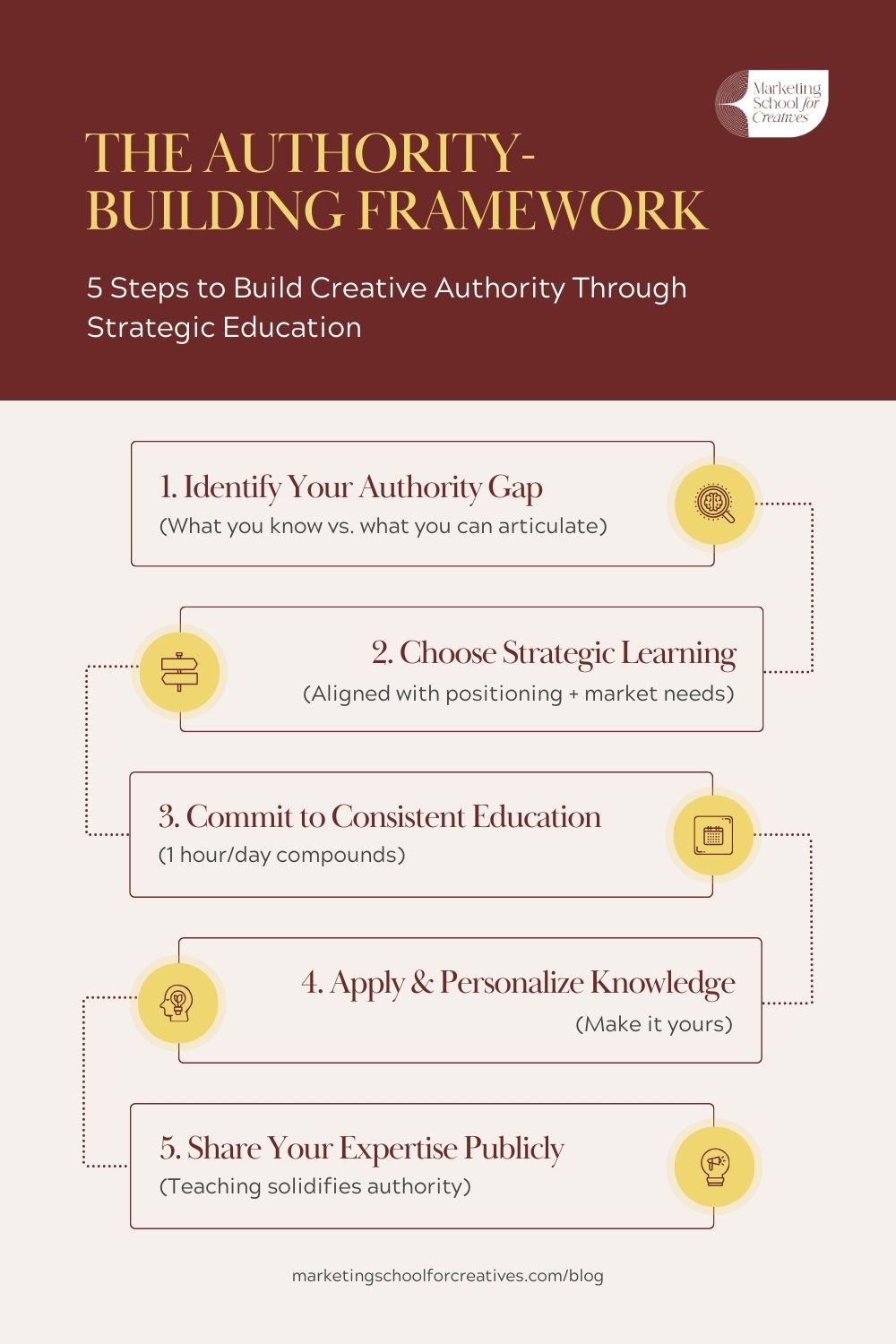
The 5-Step Authority-Building Framework:
- Identify your authority gap (what you know vs. what you can articulate)
- Choose strategic learning (aligned with your positioning and market needs)
- Commit to consistent education (1 hour/day compounds)
- Apply and personalize knowledge (make it yours)
- Share your expertise publicly (teaching solidifies authority)
Let's break down each step.
Step 1: Identify Your Authority Gap
Before you invest in education, get brutally honest about where the disconnect lives.
Ask yourself:
- Can I explain why my work is effective, not just how I do it?
- Do I have frameworks or methodologies I can reference?
- When clients ask "what makes you different?"—do I have a compelling answer beyond "experience" or "passion"?
- Does my positioning sound interchangeable with other creatives in my field?
The gap isn't about lacking skill. It's about lacking the language and frameworks to communicate the expertise you already have.
Write down specific moments where you struggled to articulate your value. Those moments show you exactly where strategic education will have the biggest impact.
Example: A photographer might create stunning compositions intuitively but can't explain the psychology behind why certain images resonate more deeply. That's the gap—and learning visual psychology principles fills it.
Step 2: Choose Strategic Education (Not Random Learning)
Not all education builds authority equally. Choose learning aligned with:
Your positioning/niche: If you specialize in luxury branding, study luxury consumer psychology. If you focus on sustainable design, learn environmental impact frameworks.
Client pain points: What do your ideal clients need you to explain or justify? That's where your education should focus.
Market gaps: What expertise is missing in your field? Where can you become the authority no one else is?
Types of strategic education:
- Certification programs (structured, credible)
- Specialized courses (niche methodologies)
- Industry research and studies (data-backed knowledge)
- Mentorship from recognized authorities
Don't just collect certificates. Choose education that gives you applicable frameworks you can integrate into client conversations, proposals, and positioning.
(And yes, I'm looking at everyone who has 47 course login credentials saved but hasn't finished a single one. 👀 No judgment—just saying that one completed program beats ten abandoned ones every time.)
Step 3: Commit to Consistent Learning (Small Efforts Compound)
Remember Janet's approach: one hour a day. Or every other day. Whatever fits your life.
You don't need to quit your business, take a sabbatical, or clear your calendar.
Set up a learning system that works:
- Calendar blocks (treat it like client work—non-negotiable)
- Morning study sessions (before the day gets chaotic)
- Audiobooks or podcasts during commutes
- Weekend deep-dives when you have more focus time
One hour a day = 365 hours of learning over a year. That's more than most people invest in professional development over 5 years.
Small, consistent investment compounds into expertise that sets you apart.
Step 4: Apply Knowledge Immediately (Don't Just Consume)
The difference between education that builds authority and education that collects digital dust? Application.
After each learning session, ask:
- How does this apply to my current projects?
- What example from my work demonstrates this principle?
- How can I integrate this framework into my client process?
- What's one way I can share this knowledge publicly?
Janet said it perfectly: "Just grab it and make it your own."
Don't just learn frameworks—personalize them. Add your creative interpretation. Make the methodology uniquely yours.
That's how you go from "I learned about [X framework]" to "I use my proprietary [X] methodology based on [research]."
Example: A brand strategist learns consumer psychology, then creates a signature "Brand Psychology Audit" methodology. They didn't just learn theory—they made it theirs.
That's how education becomes authority. ✨
Step 5: Share Your Expertise Publicly
Authority isn't built in private. Once you have frameworks and validated expertise, let people see it.
Ways to demonstrate your knowledge:
- Content creations: Write blog posts, create videos, post educational content explaining frameworks you've learned. Teach what you know.
- Speaking opportunities: Pitch yourself to podcasts, conferences, or local events as an expert in your specialty.
- Teaching: Offer workshops, webinars, or mentorship. Teaching solidifies authority faster than almost anything else
- Client education: Integrate your learning into discovery calls, proposals, and project presentations. Show clients the 'why' behind your approach.
The more you share your expertise, the more you're recognized for it. It's that simple.

Authority-Building Education Options for Creative Professionals
So what kind of education actually builds authority? Here are your main options—choose based on your positioning, budget, and how much structure you need.
Certification Programs: Structured Authority Building
Best for: Creatives seeking formal recognition in a specialized area.
Pros: Credibility signal, comprehensive curriculum, recognized credential you can reference.
Cons: Time investment, cost, may not be available in all niches.
Not every niche has certification options yet. If you're specializing in something super specific like "brand photography for sustainable fashion startups in the Pacific Northwest," you might need to get creative about combining multiple educational resources. That's totally fine.
Examples across disciplines:
- Design: Neuroaesthetics certification, biophilic design, sustainable design credentials
- Photography: Certified Professional Photographer (CPP), specialized lighting certifications
- Brand strategy: StoryBrand certification, brand psychology programs
- General: Marketing, business strategy, project management certifications
Choose certifications that give you frameworks, not just badges. The credential should come with knowledge you can immediately apply and articulate.
Strategic Courses & Programs: Niche Expertise
Best for: Building expertise in a specific methodology without full certification commitment.
Pros: Focused learning, often self-paced, more affordable than certification.
Cons: Less formal credibility signal (but still valuable if content-rich).
What to look for:
- Courses with application and implementation (not just theory)
- Programs that teach frameworks you can reference
- Education from recognized authorities in your field
- Structured curriculum with clear outcomes
Example: Marketing School for Creatives provides comprehensive marketing education specifically for creative professionals—giving you frameworks, language, and strategic knowledge that positions you as a marketing-savvy creative. (That's a rare combination that commands premium rates—because marketing-savvy creatives are unicorns in the best way ✨)
You learn the E3 Storytelling Framework, positioning strategies, and visibility tactics that immediately differentiate you.
The key is choosing programs that give you communicable expertise—not just inspiration or tactical tips.
Self-Directed Learning: Books, Research, Mentorship
Best for: Creatives who thrive with autonomy and want to curate their own education path.
Pros: Flexible, often lower cost, highly customizable to your specific needs.
Cons: Requires discipline, less structured, no formal credential, harder to demonstrate "proof" of expertise.
Approach:
- Read foundational books in your niche (design psychology, color theory, brand strategy, etc.)
- Study industry research and case studies (Harvard Business Review, industry journals, academic papers)
- Seek mentorship from established authorities
- Cross-pollinate learning from adjacent fields (neuroscience for designers, storytelling for photographers, etc.)
Self-directed works best when combined with application—don't just consume, create your own frameworks based on what you learn.
Now, I know what you might be thinking...
"But Wait—I Have Concerns About This"
Let's address the most common objections I hear from creatives about investing in strategic education.
"I Don't Have Time for This"
You spend 1-2 hours a day on social media. (Not judging—we all do.)
One hour of strategic learning, consistently, will build more authority than 100 hours of content creation without a clear positioning.
Janet managed one hour a day while running a full-time design business. If your business success depends on being recognized as an expert, this is where your time investment pays exponential returns.
And honestly? The confidence you gain from validated expertise will make every client conversation, content piece, and sales pitch more efficient. You'll save time by not second-guessing yourself constantly.
Time keeps moving forward. The question isn't whether you have time—it's whether you want to spend that time building authority or staying stuck in the same patterns.
"I Can't Afford Expensive Programs Right Now"
Fair question. Let's look at ROI.
One premium client pays for most certification programs. If strategic education helps you articulate your expertise clearly enough to:
- Close one additional high-value client
- Raise your rates by 20-30%
- Win one speaking opportunity that leads to referrals
- Reduce the sales cycle because clients trust you faster
...the financial return happens quickly.
And honestly? The cost of not investing is higher. How much revenue have you already left on the table by not being able to articulate your value clearly?
Education exists at every price point—from books ($20) to courses ($200-$500) to certifications ($1,000-$3,000+).
Start where you can. Read the research. Take a foundational course. Build from there. But don't let cost be the excuse that keeps you invisible.
"I'm Not Sure Which Education to Pursue"
Start with your positioning. What do you want to be known for? Where do your ideal clients need the most explanation or justification?
Ask successful creatives in your field: "What education was most valuable for your business?"
Trial before committing: Start with books or introductory courses in an area. If it resonates and you see immediate application, invest in deeper structured learning.
The worst decision is no decision. (Paralysis by analysis never built anyone's authority. Ask me how I know. 😅)
Pick one area where strategic knowledge would immediately elevate your positioning, and start there. You can always expand later. ✨
If you're done waiting for 'someday' and ready to build authority starting today, our free masterclass shows you exactly how high-earning creatives position themselves as experts. Watch the masterclass →
What Happens When You Build Authority Through Education
Let's talk about what shifts when you stop waiting for experience to build your authority and start using strategic education instead.
Immediate Shifts (Week 1-4)
And by immediate, I mean immediate—like, first-client-conversation-after-you-finish-the-first-module immediate.
- Confidence in conversations. You stop hedging. You reference frameworks. You explain why your approach works, not just what you do. Clients feel the difference—suddenly you sound like the expert they need, not someone hoping to convince them.
- Clearer positioning. Education forces you to articulate your methodology. You can't learn frameworks without understanding how they apply to your work specifically. That clarity becomes your positioning.
- Better content. You're no longer staring at a blank screen wondering what to say. Frameworks give you endless content angles—principles to explain, research to reference, applications to demonstrate.
Short-Term Results (3-6 Months)
- Higher conversion rates. When you can articulate expertise clearly, clients trust you faster. Less convincing, more enrolling. Your sales conversations become education sessions where the value is obvious.
- Premium pricing justified. "I'm expensive because I'm good" doesn't land. "I use [X framework] grounded in [Y research] that delivers [Z outcome]" does. Education gives you the language that justifies your rates. (Finally. Because you're worth it, and now you have the vocabulary to prove it.)
- Industry recognition. Speaking invitations. Podcast requests. Panel discussions. Media features. The opportunities Janet described as "manifesting" start appearing—because you're demonstrating knowledge the industry values.
Long-Term Impact (6-12+ Months)
- Thought leadership positioning. You become THE expert in your specialty. Not just someone who does good work, but the person others reference, learn from, and recommend.
- Compounding opportunities. One speaking gig leads to three more. One collaboration opens doors you didn't know existed. Client referrals come pre-sold because your authority precedes you.
- Career expansion. Teaching opportunities. Consulting offers. Product creation. Book deals. Your authority creates options beyond client work—diversifying income and impact.
- Legacy building. You're not just running a business—you're contributing to your industry's knowledge base. Shaping conversations. Elevating the entire field.
And here's what Janet experienced: energy instead of burnout. Recognition instead of proving. "I find it fascinating and it energizes me." When you're recognized for your expertise instead of constantly proving it, work feels different. ✨

Your Next Steps: Start Building Authority Today
You have the framework. You've seen what's possible. Now let's make this actionable.
This Week
Yes, this week. Not "someday" or "when things slow down." This week. I'll wait. ⏰
- Identify your authority gap. Spend 30 minutes answering: Can I explain why my work is effective? Do I have frameworks I reference? Do I sound different from other creatives in my field?
- Research 3 education options in your niche. Certifications, courses, or books that would give you frameworks aligned with your positioning.
- Commit to 1 hour of strategic learning. Read industry research. Listen to an expert podcast. Start somewhere.
This Month
- Enroll in one strategic course or program. Don't overthink it—choose education that addresses your authority gap and fits your budget.
- Create your learning schedule. Block time like client work. Make it non-negotiable.
- Apply knowledge immediately. After each learning session, ask: How does this apply to my current projects? What example demonstrates this principle?
- Share one insight publicly. Post, write, teach—let people see what you're learning.
This Quarter
- Complete foundational education. Finish the program or course you started. Make it your own.
- Update your positioning. Revise your bio, website, and client materials with new frameworks and credentials.
- Pitch one speaking opportunity or write one article using your expertise. Start building your thought leadership presence.
- Seek one teaching or mentorship opportunity. Teaching solidifies authority.
This Year
- Build comprehensive knowledge in your specialty. Layer education—courses, certifications, research, mentorship.
- Create your signature methodology based on what you've learned. Make it uniquely yours.
- Establish consistent thought leadership. Share your expertise regularly through content, speaking, or teaching.
- Track the opportunities that manifest from your authority positioning. Speaking invites, client inquiries, collaborations, media features.
One year from now, you could be the creative everyone's referencing as THE expert in your field. Or you could still be waiting for experience to build your authority.
The choice is yours. ✨
Don't Wait 20 Years to Wish You'd Started Sooner
Remember the two photographers from the beginning?
One spent decades hoping their work would speak for itself. The other invested in strategic education that gave them frameworks to articulate their expertise—and commanded premium rates within 3 years.
Both were talented. Both had portfolios full of beautiful work.
The difference? One understood that authority isn't built by waiting. It's built by learning strategically and sharing generously.
A design industry veteran said it best after attending a workshop on science-based design: "I wish I had known all of this 20 years ago."
Don't let that be your story.
You already have the talent. The portfolio. The client results. What you're missing is the strategic education that turns intuitive expertise into articulated authority—the kind that opens doors, commands premium rates, and positions you as the obvious choice.
Strategic education isn't a luxury. It's an investment in the business you're building and the industry impact you want to have.
🚀 Ready to start building your authority through strategic education? Don't wait 20 years to wish you'd started sooner.
Our free masterclass reveals:
- The 3 positioning shifts that help creatives command premium rates
- How to market your expertise (even before you have decades of experience)
- The education strategy high-earning creatives use to stand out
